I am almost finished reading the MacCulloch's biography on Thomas Cranmer. On the back of the book one of the reviews says that the book is "...constantly absorbing...". Trust me, this book is not constantly absorbing.
My thoughts on Cranmer after reading this have changed. I guess I do not see him as a great liturgical genius. He did not write the BCP from scratch. It is better to say that he compiled it, as he borrowed from ancient, medieval, and contemporary sources. To be sure, he did write certain parts of it - certain prayers here and there, the litany, etc. - but much of the rest of it was borrowed from other sources. I don't think there is anything wrong with that, mind you, but it only goes to show that he was not some "fountain" of fine liturgy in and of himself.
I used to feel sorry for him since he was martyred under Mary, along with Latimer and the others, at Oxford. I mean, who can't feel sorry for a martyr? But I actually learned that he had people burned at the stake (traditionalists, anabaptists, etc.) too when he was in power. So it seems that he got what he deserved. It is funny, because this morning the Psalm appointed for the morning office in the 1928 BCP is Psalm 18, which speaks of one being rewarded according to his works.
All I can say is that I am glad that there wasn't any theology surrounding him or his office that made him the infallible 'vicar of Christ', otherwise we'd all be in trouble. Think about: "The Primate of All Engalnd, Thomas Cranmer, speaks ex cathedra and declares that the Eucharist is purely a memorial, and that this doctrine is to be held by all the faithful." That would be scary. Anglicans have been able to look back on him, and acknowledge his faults and wrong ideas in certain areas, and make appropriate changes. Cranmer wasn't all bad by any strech of the imagination. But I certainly wouldn't have kept him as my ABC if I was king!
Tuesday, February 28, 2006
Thursday, February 23, 2006
Ecumenism Gone Awry
Recently I went to the installation service for the new rector of Bishop Cummins Reformed Episcopal Church in Catonsville. Bp. Cummins was the founding bishop of the REC. It is interesting to note that before he became a bishop, he served as a curate at St. Peter's Church, which later merged with Grace Church, and became Grace and St. Peter's Episcopal Church. The thing that makes it interesting is that GASP, as it is known here in Baltimore, is the spikiest, most anglo-papist ECUSA parish around.
Anyway, while at the installation I met people from all sorts of denominational backgrounds. Some, when I told them that I attended a Roman Catholic seminary, became sort of stand-offish towards me, even though we had enjoyed pleasant small talk up till I revealed the "dreaded news" to them.
It amazes me how some people still have such strong prejudices towards Roman Catholicism. It is almost as though the pope personally did something to these people. Of course, most of the time these people know nothing about Roman Catholic dogma or teachings other than what they have heard from their own pope - Pope ______ (insert name of your denominational leader) - so their hatred is really ill-informed. What these folk fail to see, though, is that they can place their own souls in serious spiritual jeopardy by harboring such bitterness, anger, and hostility towards others. They think that they have "righteous indignation", and that their rage is somehow jusitifed, unfortunately they become so blinded by their hatred that they can no longer even consider trying to see something from another person's (or church's) perspective.
Thomas Merton, in Seeds of Contemplation, talks of detachment. Briefly, detachment is essentially to focus on the universal, not the particular. It is not focusing on the thing in itself, but rather to focus on what is beyond the thing - what the thing points to. So for example, prayer is good, obviously, but when we become so obsessed with prayer itself we can get the point where we can no longer pray. Solemn liturgy and vestments are wonderful, and play an important role in the spiritual life, but they are a means to an end - not the end itself. Without detachment, something good can be used for great evil.
Detachment, I think, is part of the process of overcoming the denominational prejudices that we all hold on to, and what the people I met need to try to cultivate in their lives. They, and many of us as well, sometimes forget that the point of our dogmas and doctrines is growing in deeper knowledge and love of God, and having a more intimate communion with Him. Some people think that the point of dogma and doctrine is to have right dogma and doctrine. Our theological constructs or systems become our God. When we harbor hatred and rage towards people who do not believe the same way that we do, even if we are truly convinced that we are right, then we become clanging cymbals. And even worse, we put our own souls in danger of Hell.
Anyway, while at the installation I met people from all sorts of denominational backgrounds. Some, when I told them that I attended a Roman Catholic seminary, became sort of stand-offish towards me, even though we had enjoyed pleasant small talk up till I revealed the "dreaded news" to them.
It amazes me how some people still have such strong prejudices towards Roman Catholicism. It is almost as though the pope personally did something to these people. Of course, most of the time these people know nothing about Roman Catholic dogma or teachings other than what they have heard from their own pope - Pope ______ (insert name of your denominational leader) - so their hatred is really ill-informed. What these folk fail to see, though, is that they can place their own souls in serious spiritual jeopardy by harboring such bitterness, anger, and hostility towards others. They think that they have "righteous indignation", and that their rage is somehow jusitifed, unfortunately they become so blinded by their hatred that they can no longer even consider trying to see something from another person's (or church's) perspective.
Thomas Merton, in Seeds of Contemplation, talks of detachment. Briefly, detachment is essentially to focus on the universal, not the particular. It is not focusing on the thing in itself, but rather to focus on what is beyond the thing - what the thing points to. So for example, prayer is good, obviously, but when we become so obsessed with prayer itself we can get the point where we can no longer pray. Solemn liturgy and vestments are wonderful, and play an important role in the spiritual life, but they are a means to an end - not the end itself. Without detachment, something good can be used for great evil.
Detachment, I think, is part of the process of overcoming the denominational prejudices that we all hold on to, and what the people I met need to try to cultivate in their lives. They, and many of us as well, sometimes forget that the point of our dogmas and doctrines is growing in deeper knowledge and love of God, and having a more intimate communion with Him. Some people think that the point of dogma and doctrine is to have right dogma and doctrine. Our theological constructs or systems become our God. When we harbor hatred and rage towards people who do not believe the same way that we do, even if we are truly convinced that we are right, then we become clanging cymbals. And even worse, we put our own souls in danger of Hell.

The Fullness of the Faith
Just got back from a stained glass meeting with a nun at a "Moscow Patriarchate" Russian Orthodox Church (the real Russian Orthodox Church, she was careful to point out, not the liberal OCA). When she asked what I was and I told her she said, "Ahhh, I was once Anglican." Of course, I assumed that since she had an English accent. "But I found the fullness of the faith in Orthodoxy." she went on. She then told me she'd pray for me.
Now, I happen to be personally acquainted with the former priest of that parish, a life long Russian Orthodox, who left, and is now a priest in a continuing Anglican jurisdiction. Apparently he found that traditional Anglicanism has the fullness of the faith as much as orthodoxy!
Now, I happen to be personally acquainted with the former priest of that parish, a life long Russian Orthodox, who left, and is now a priest in a continuing Anglican jurisdiction. Apparently he found that traditional Anglicanism has the fullness of the faith as much as orthodoxy!
Tuesday, February 21, 2006
Poll: What Type of Vestments Should I Buy?
Lord willing, I will be ordained to the sacred priesthood this spring. So I am currently in the market for vestments and such. I already own a nice, modern gothic white chasuble and white cope (both purchased in Rome). But obviously I will need to buy more vestments. I am thinking of getting the old Latin-Style vestments. Any thoughts or opinions on that?
Monday, February 20, 2006
Anglican Identity
I am always amazed at the loyalty of the sons and daughters of the Roman Catholic Church. In Baltimore (the nation's first Roman Catholic See), it seems like every third person is Roman Catholic, and being Catholic always seems to be a strong part of their identity, even if they do not follow the Magesterium's teachings or regulations. I always come across Catholics at parties or wherever, who rarely, if ever, attend mass, or who live in some gross and open sin, such as cohabitating. Yet they consider themselves to be "serious" Catholics on some level; and, if they do go to church one Sunday, it is going to be a Catholic church! Or if they want to get married, then it will be a Catholic wedding. I am even more amazed when I see some of these hideous suburban parishes, like the one in the post below, full of people for weekday masses, devotions, etc. The place is extremely ugly, and has music to match, yet it is full of people. It is truly amazing and inspiring the loyalty these people have to the Church of Rome. Even if they do not always follow her rules, or do all of the devotions, they would probably die at the stake for her. Again, it is very awe-inspiring. This loyalty is rooted in their strong Catholic identity, and whatever that means for them.
We can learn something from this. I think Anglicans need to exploit the "Anglican Identity" better than we currently do. It might help strengthen our parishes and reach out ot new people. This identity includes not only a "temperate" sort of mindset, or other rather nebulous characteristics, but also certain obvious "particulars" that we are all sometimes take for granted. There is, in other words, a general "Anglican" identity, I think, that we can all tap into to build strong loyalty. The strongest and most obvious parts are things like: the traditional language in the traditional BCPs; the classical Psalter and Anglican Chant; saying mass facing east; the hymns; Morning and Evening Prayer (done in church with a cassock, surplice, tippet, and hood - or read at home with family once or twice a week, if not more); singing the works of Vaughn-Williams, Stanford, Howells, and Willan; the KJV; the 1940 Hymnal; the Eucharistic Fast, as well as fasting on Fridays throughout the year (something Roman Catholics no longer do); and a lot more. And if we are Anglo-Catholic, then there are even more traditions that we can teach and pass on, all to build up the "Anglican Identity".
I think that if we really identify some aspects of our identity, we can exploit them in a good sense, so as to strengthen peoples' commitment to being "Anglican" Christians, and, by extension, their commitment to Jesus Christ. There are people who have this mindest already, and who, like Catholics of the same mindset, do not attend mass regularly, etc. I am not saying we want to make a bunch of new people like that (talk about aiming low!), but at least those people are "in the fold" as it were, and we can work on helping them deepen their devotional like (like the Roman Church tires to reach out to these non-practicing "cultural" Catholics). These Christian identities, Catholic, Anglican, Orthodox, Mennonite, usually keep people from wandering too far away, and keeps them within easy reach to pull back to the Shephed every now and then.
We can learn something from this. I think Anglicans need to exploit the "Anglican Identity" better than we currently do. It might help strengthen our parishes and reach out ot new people. This identity includes not only a "temperate" sort of mindset, or other rather nebulous characteristics, but also certain obvious "particulars" that we are all sometimes take for granted. There is, in other words, a general "Anglican" identity, I think, that we can all tap into to build strong loyalty. The strongest and most obvious parts are things like: the traditional language in the traditional BCPs; the classical Psalter and Anglican Chant; saying mass facing east; the hymns; Morning and Evening Prayer (done in church with a cassock, surplice, tippet, and hood - or read at home with family once or twice a week, if not more); singing the works of Vaughn-Williams, Stanford, Howells, and Willan; the KJV; the 1940 Hymnal; the Eucharistic Fast, as well as fasting on Fridays throughout the year (something Roman Catholics no longer do); and a lot more. And if we are Anglo-Catholic, then there are even more traditions that we can teach and pass on, all to build up the "Anglican Identity".
I think that if we really identify some aspects of our identity, we can exploit them in a good sense, so as to strengthen peoples' commitment to being "Anglican" Christians, and, by extension, their commitment to Jesus Christ. There are people who have this mindest already, and who, like Catholics of the same mindset, do not attend mass regularly, etc. I am not saying we want to make a bunch of new people like that (talk about aiming low!), but at least those people are "in the fold" as it were, and we can work on helping them deepen their devotional like (like the Roman Church tires to reach out to these non-practicing "cultural" Catholics). These Christian identities, Catholic, Anglican, Orthodox, Mennonite, usually keep people from wandering too far away, and keeps them within easy reach to pull back to the Shephed every now and then.
Friday, February 17, 2006
Great New Anglican Blog
Here is a fantastic new Anglo-Catholic blog.... check it out!
http://www.philorthodox.blogspot.com/
http://www.philorthodox.blogspot.com/
The Aliens Have Landed
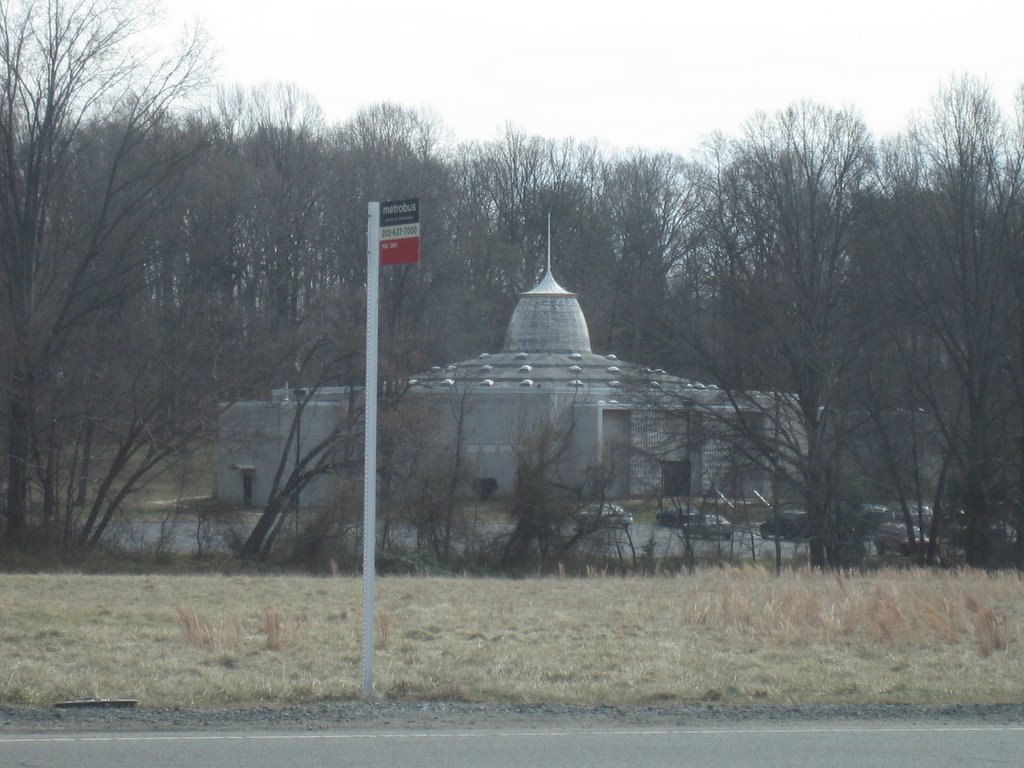
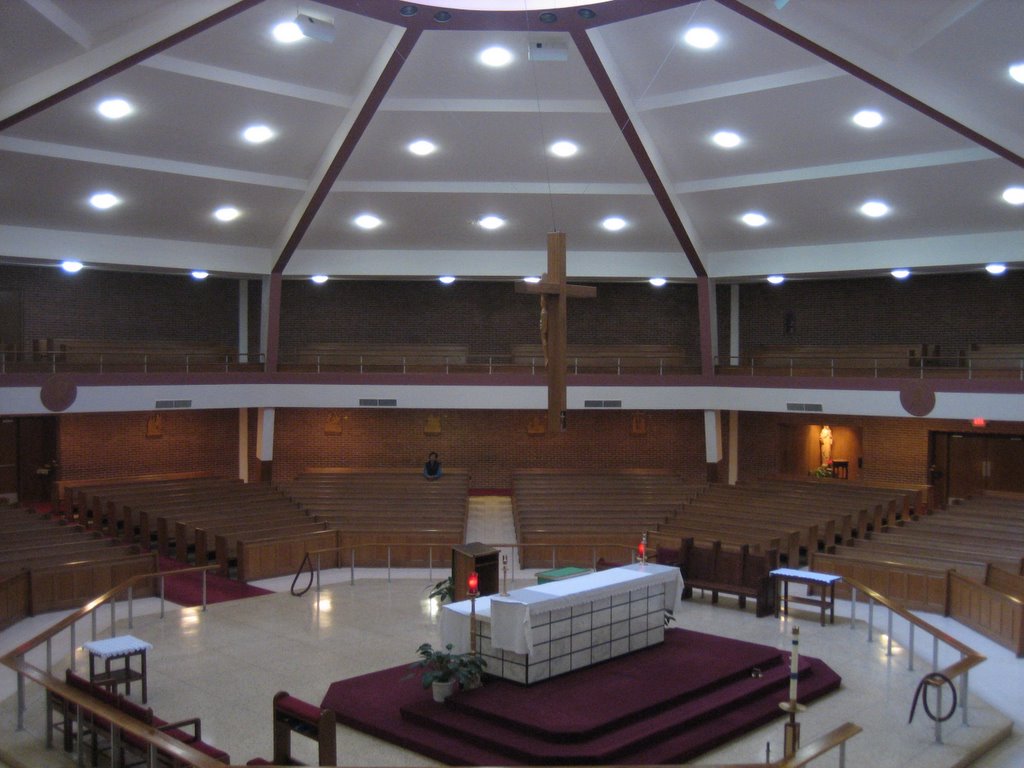
Part of my secular work includes working in church restoration and preservation. That means that I get to go all over the area and snoop around dusty old churches taking measurements, and pictures, and things. It is really fun, and I have gotten to see some absolutely amazing places over the years. Once in a while, though, I see some places that absolutely make me want to vomit.
Check out this absolutely hideous Romanist parish I saw in today in Fairfax County, Virginia. It looks like the space ship out of a really bad 1950's sci-fi film . The baptismal font is surrounded by this incredibly tacky, faux-metal grate, and has a round light above it with all of these little dead bugs in it. There are no windows inside the church; and I don't mean stained glass.... I mean no windows at all! I guess aliens do not like natural light. The nave looks like a massive transporter chamber. Luckily I managed to escape from the place before a bunch of "little green men" came out to zap me with their ray guns.
Here is there staff as listed on the bulletin:
Bishop: Yoda
Pastor: Obi-Wan Kenobi
Deacon: Luke Skywalker
Former Assistant (now deposed due to a pedophilia scandel): Anakin Skywalker
Cantor: Chewbacca
Altar Guild: Princess Leah
Custodian: Han Solo
Parish Treasurer: Jabba the Hutt
Disgruntled Former Member: Darth Vader (joined the Lutheran Church across the street, which is pastored by the "Emperor")


Check out this absolutely hideous Romanist parish I saw in today in Fairfax County, Virginia. It looks like the space ship out of a really bad 1950's sci-fi film . The baptismal font is surrounded by this incredibly tacky, faux-metal grate, and has a round light above it with all of these little dead bugs in it. There are no windows inside the church; and I don't mean stained glass.... I mean no windows at all! I guess aliens do not like natural light. The nave looks like a massive transporter chamber. Luckily I managed to escape from the place before a bunch of "little green men" came out to zap me with their ray guns.
Here is there staff as listed on the bulletin:
Bishop: Yoda
Pastor: Obi-Wan Kenobi
Deacon: Luke Skywalker
Former Assistant (now deposed due to a pedophilia scandel): Anakin Skywalker
Cantor: Chewbacca
Altar Guild: Princess Leah
Custodian: Han Solo
Parish Treasurer: Jabba the Hutt
Disgruntled Former Member: Darth Vader (joined the Lutheran Church across the street, which is pastored by the "Emperor")



Tuesday, February 14, 2006
Stand Up For Jesus - April 8, 2005
As promised, here is the latest installment of the Rev'd Fr. Chandler Holder Jones, SSC's travle diary from the "Stand Up For Jesus" meeting of the SSC in England last spring. Enjoy!
"Friday 8th April 2005 will ever remain one of the most wonderful days of my life. Our official Society of the Holy Cross pilgrimage to the Shrine of Our Lady of Walsingham had finally arrived. There are 1100 plus members of the Society throughout the world, with over 700 in the United Kingdom. Large numbers are also present in the United States, Canada, the West Indies, and Australia, with a few in Africa and other places. A significant collection from North America and from Australia was present for the SSC event, most of whom had never been to Our Lady’s Shrine at Walsingham. For this reason, and to acknowledge the prominent place of Walsingham in the Catholic Revival, we made a pilgrimage to Walsingham on Friday. Several coaches of priests made their way to distant Norfolk on that cold blustery day. Father Hope Patten, the Restorer of the Shrine, was a brother of the SSC, like so many other famous Anglo-Catholic priests throughout history. The morning was, as the BBC predicted the night before, surprisingly cold, sharply so. The dark swirl of grey and white clouds above, the wind so sharp it felt like it would cut through you, the pelting droplets of rain all combined to create an almost surreal atmosphere for a day that would be indeed unlike any other. The condition of the weather seemed a fitting commentary on the fact that the Pope would be buried that very morning in Rome. John Paul II had only died less than a week before. In fact, as it turned out, probably 200 of our brethren decided not to join us for the Walsingham pilgrimage because they were glued to the television to watch the proceedings from the Vatican. However, nothing on earth could have stopped me from going to England's Nazareth that day! After a hurried breakfast we all made our way onto the coach omnibuses that would drive us three hours northeast to the county of Norfolk and the ancient Shrine of Our Lady. Behind me was Canon Charles Hough of Fort Worth, Texas and his lovely wife. As I sat down, donning cassock, biretta, and bag, I was joined by a elderly English priest who made his acquaintance and politely asked if he could sit next to me. I of course said 'yes' - it was one of the best yeses of my life. For six hours that day I enjoyed the unique privilege of being graced by the company of a Catholic priest's priest, the retired Archdeacon of Croydon, a former missionary, parish vicar, teacher, theologian, a living embodiment of the Oxford Movement. All the way up to Walsingham and back we talked and talked (not an unnatural activity for me, as anyone who knows me will testify!); we discussed politics American and British, the Churches of England and Rome, the controversies in the Church, immigration in Europe, Anglo-Catholicism past and present, and on and on. It was one of the most illuminating times I have ever spent with anyone, and additionally, it certainly helped to pass the time quickly as we made our way north and south. The beauty of the English countryside itself is a mesmerising and enchanting experience, and so I must confess I kept one eye on my companion and the other out the window upon the clash of rolling hills and big sky, grey clouds and bright green grass, and the seemingly endless steeples peaking above the horizon as we made our way through 'England's mountains green.'
I should pause here for a moment and describe exactly what is the Shrine of Our Lady of Walsingham. It is the national Shrine of the Blessed Virgin Mary in England, the spiritual epicentre of world Anglo-Catholicism. In AD 1061 the Holy Mother of God appeared in a vision to a Saxon noblewoman, Richeldis de Faverches, and commanded that a Shrine in honour of the Incarnation of Our Lord Jesus Christ and the Holy Family be built on her land. Our Lady revealed the design she desired to be built, a small house, a replica of the Holy House in which the Annunciation from the Archangel Gabriel took place and in which the Holy Family dwelt at Nazareth. A miraculous well sprung up in the place chosen by the Mother of God for the erection of the Shrine, and so the original Holy House was built thereon. Eventually the small chapel consisting of the House itself was transformed first into a great pilgrimage Church, and later an entire Augustinian Priory surrounded and protected the little House of England's Nazareth. Augustinian Canons governed and administered the largest centre of Marian pilgrimage in all of Europe dating from 1146. The most popular place of Marian pilgrimage in the country, it closely rivalled the Shrine of Saint Thomas of Canterbury for overall celebrity. Over the centuries the Kings of England offered their royal patronage to the Shrine and endowed it with gifts of all kinds: Henry III, Edward II, Edward III, Henry IV, Edward IV, Henry VII, and Henry VIII all made pilgrimage to the Shrine of the Mother of God in Walsingham. The wicked King Henry VIII, at the dissolution of the monasteries, brought about the destruction of Our Lady's House and Shrine in 1538. The devotion lay in abeyance until a young Anglican vicar, Father Alfred Hope Patten, moved to Walsingham in 1921 with the hope of restoring the ancient Shrine as well as the ancient Faith. A leader of the Catholic Movement in the Church of England, the energetic Father Patten restored the fullness of Catholic doctrine and practice to the parish Church of Saint Mary's, Little Walsingham, and in 1922 he restored the Image of Our Lady of Walsingham inside the parish Church at the north side of the building. It was his idea to base the new statue of Our Lady of Walsingham on the Image depicted on the seal of the medieval Priory. Regular pilgrimage and devotion was returned to Walsingham. >From the first night the Image was restored, people gathered to offer their intercessions in union with the prayers of Our Lady, and the ministry of prayer, intercession, and devotion has gone on unbroken every day since. Father Patten firmly believed that if the Church of England were truly a Catholic Church, it must have a living centre of devotion to the Mother of the Lord. The Restoration of the Shrine was for him a proof of Anglicanism's Catholicity and a vital connexion with her pre-reformation Faith and history. Throughout the 1920's, the trickle of pilgrims became a flood of large numbers, for whom eventually a Pilgrim Hospice was opened (a hospice is technically the name of a place of hospitality for pilgrims) and in 1931, a new Holy House encased in a small pilgrimage church was dedicated, and the Image translated there with great solemnity. In 1938 that church was enlarged to form the Anglican Shrine of Our Lady, more or less as we know it today. Catholic Anglicans around the world continue to flock to England's Nazareth to worship and adore the Divine Son of Mary, Jesus Christ, and to venerate God's lowly Mother. Devotion to Our Lady under the title of Walsingham has become an undoubted defining characteristic of the Anglican Catholic. 15 October 1931 is today commemorated as the Feast of Our Lady of Walsingham. Last year, in 2005, the Anglican Shrine was ranked by the BBC as Britain's most popular and loved site of Christian pilgrimage and prayer: the dream of Father Patten has been realised and Walsingham is once again the centre of English Catholic life and devotion!
Now to pick up my narrative. Once we arrived in Norfolk the weather had turned colder and brisker, and for the first time snowflakes appeared dancing in air. The atmosphere on the bus was one of palpable excitement, the air was electric with joy and anticipation. Everyone was so excited that they chatted vigorously. Once we arrived at the Holy Mile, an authoritative voice came over the speaker and commanded us to keep a prayerful silence, and we did. The Holy Mile tracks the ancient route along the River Stiffkey from the Slipper Chapel to the Anglican Shrine: the Slipper Chapel, which now serves as the national Romanist Shrine of Walsingham, was in the medieval period that place at which pilgrims removed their shoes or slippers and from which they walked barefoot to the Shrine a mile distant. It is the last leg and holiest stretch of the old pilgrimage route to Walsingham. I recall vividly the scene in the cold of that frosty spring morning as we pulled up to the front of the Shrine Church and our entourage quietly departed the buses and made its way into that venerable and loved Church for our opening devotion and prayers. There are 15 Altars in the Shrine Church in honour of the 15 Mysteries of the Holy Rosary. After our prayers before the first Altar of the Annunciation and some time in the Holy House in prayer before the sacred Image, we walked en masse from the Shrine in the village up the hill to the parish Church of Saint Mary's for an utterly unique treat, my first Mass celebrated in the parish of Father Alfred Hope Patten. As we darted up the small incline to the church, the sky opened from its grey shell and a burst of sunlight poured out on the group. The Lord Jesus seemed personally to welcome us to this holy place in honour of His wondrous Incarnation, to which we had come from such great distances. As other priests hurriedly scooted into the church I could not help but stop motionless before the small and very humble grave of Father Patten, which is located just outside the west door of the church building. In silence I recounted all the wonderful works he had accomplished in his long life, offered a prayer for his repose, and joined the rest of the eager band as they made their way inside. The Church of Saint Mary's is a new beautifully-reconstructed building of radiant white interior and clear glass, bright and happy. A beautiful stained-glass window on the east wall behind the Altar clearly depicts Henry VIII, Father Patten, and a church on fire. The burning church in the original Saint Mary's, which was gutted by fire in 1961, during the ministry of the famous Father Colin Stephenson. The ancient church building's interior had been almost entirely destroyed; precious little of the original design remained afterwards - but what did remain was carefully incorporated into a faithful and handsome replacement.
Since I had paused outside I was late, and many priests were already vested and had hungrily seized their seats up in the chancel on either side of the 'Cranmerian Holy Table' which was set up in the middle of the church crossing. Oddly enough the lovely red and gold High Altar and reredos had been obscured the large freestanding table plopped in front of it. You see, this was to be a concelebrated Mass in the modern Rite, typical of British Anglo-Catholicism. As much as I admire and respect the faith and courage of my British brothers, I still cannot acclimate myself to the liturgical modernity expressed there. 'When Rome sneezes, Anglo-Catholics get the 'flu.' I confess I find this particular 'Rome-aping' not only unnecessary, but theologically and aesthetically undesirable. Anyway, I rushed over to a grand piano hidden on the north side of the nave, concealed by bag, vested as fast as I could in alb and concelebration stole (very mod), put my biretta on my head and flung myself at the chancel. It was full. Several American priests chuckled at my biretta; one snobbishly remarked that the English would think I was crazy or eccentric or both. I ignored the comment and started looking for a seat. Things looked dire - all my life I had been looking forward to having the privilege of celebrating Mass in this Church and it appeared I was to be relegated to a seat in the congregation. All of a sudden, as things usually happen at Walsingham, a little gift mysteriously materialised. My new friend, the retired Archdeacon, had saved me a seat, a seat on the front row right next to the Altar. He and I would stand adjacent to the concelebrating Bishops for the Mass. It was an indescribable blessing. I took my seat and minutes later the Mass began. We sang the Angelus as the sacred ministers stood before the parish shrine of the Virgin Mother. Offered with careful and loving reverence, the Mass unfolded flawlessly. The sight was a vision to behold, the four-hundred priests and 15 or so bishops all vested in white, Bishop Keith Ackerman of Quincy celebrating in a modern chasuble with an image of Our Lady emblazoned on the front. A religious sister with a strong cockney accent read one of the lessons. The Vicar of Walsingham, Father Patten's successor, preached a carefully-prepared and timely sermon. Then came the Liturgy of the Eucharist itself - this was the first time I had ever publicly concelebrated the Mass since my own ordination to the Priesthood. I shall never forget as long as I live standing in that beautiful church alive with spiritual power, extending my right arm and hand and saying over the sacred gifts the words of consecration: 'This is my Body...' 'This is the Cup of my Blood...' The Eternal Sacrifice of the Son of God and Son of Mary was pleaded to the heavenly Father in the praise and worship of God and the honour of His Incarnation. Once again in the mystery of the Mass, the Word was in mystic form made flesh, under bread and wine. The very Incarnation of God, celebrated in image, symbol, paint, wood, building, shrine, sacred place, was extended, made-present, once again in time and space, by Sacrament, under the veil of earthly food. Walsingham means Incarnation, God made Man, God with us. The Reality pointed to at Walsingham became our Reality once again. At Communion, a ciborium containing the Blessed Sacrament was passed very gingerly from priest to priest as each removed a fragment of a broken host and held It until all received together. At that moment I recall adoring the Lord of Glory, the Body of Mary's Child, present in my hands, the hands of an unworthy sinner who was, in spite of his innumerable sins, a priest, an alter Christus, another Christ. Like Mary, the Catholic priest is a Theotokos, a God-Bearer. The Catholic priest is himself in a mysterious way the Incarnation prolonged in history, the icon or image of the Incarnate Lord. The Church, the Mass, the Priesthood - Our Lord, Our Lady - all unites in one amazing gift of God's disclosure of Himself to and in us. Walsingham's truth came surging forth again. The chalice was passed priest to priest and all received the Precious Blood.
As the Mass concluded with all of its splendour and solemnity, that old familiar sense came flooding back once more, gratitude, gratitude to God for His many gifts, for His love which from our birth surrounds and sustains us, for the gift of Himself in becoming Man for our salvation and in forming His Church, His Mystical Body, in which we have come to live, love, and delight, and for the grace of pilgrimage to that place, England's Nazareth, where the veil between heaven and earth is thinnest - Walsingham is as close to heaven as one comes on earth. After the pontifical blessing, the coterie of priests began to form a procession which would wind through the village streets, bearing in its midst the Image of Our Lady to her Holy House. The next great Walsingham tradition was about to begin..."
Chad+
"Friday 8th April 2005 will ever remain one of the most wonderful days of my life. Our official Society of the Holy Cross pilgrimage to the Shrine of Our Lady of Walsingham had finally arrived. There are 1100 plus members of the Society throughout the world, with over 700 in the United Kingdom. Large numbers are also present in the United States, Canada, the West Indies, and Australia, with a few in Africa and other places. A significant collection from North America and from Australia was present for the SSC event, most of whom had never been to Our Lady’s Shrine at Walsingham. For this reason, and to acknowledge the prominent place of Walsingham in the Catholic Revival, we made a pilgrimage to Walsingham on Friday. Several coaches of priests made their way to distant Norfolk on that cold blustery day. Father Hope Patten, the Restorer of the Shrine, was a brother of the SSC, like so many other famous Anglo-Catholic priests throughout history. The morning was, as the BBC predicted the night before, surprisingly cold, sharply so. The dark swirl of grey and white clouds above, the wind so sharp it felt like it would cut through you, the pelting droplets of rain all combined to create an almost surreal atmosphere for a day that would be indeed unlike any other. The condition of the weather seemed a fitting commentary on the fact that the Pope would be buried that very morning in Rome. John Paul II had only died less than a week before. In fact, as it turned out, probably 200 of our brethren decided not to join us for the Walsingham pilgrimage because they were glued to the television to watch the proceedings from the Vatican. However, nothing on earth could have stopped me from going to England's Nazareth that day! After a hurried breakfast we all made our way onto the coach omnibuses that would drive us three hours northeast to the county of Norfolk and the ancient Shrine of Our Lady. Behind me was Canon Charles Hough of Fort Worth, Texas and his lovely wife. As I sat down, donning cassock, biretta, and bag, I was joined by a elderly English priest who made his acquaintance and politely asked if he could sit next to me. I of course said 'yes' - it was one of the best yeses of my life. For six hours that day I enjoyed the unique privilege of being graced by the company of a Catholic priest's priest, the retired Archdeacon of Croydon, a former missionary, parish vicar, teacher, theologian, a living embodiment of the Oxford Movement. All the way up to Walsingham and back we talked and talked (not an unnatural activity for me, as anyone who knows me will testify!); we discussed politics American and British, the Churches of England and Rome, the controversies in the Church, immigration in Europe, Anglo-Catholicism past and present, and on and on. It was one of the most illuminating times I have ever spent with anyone, and additionally, it certainly helped to pass the time quickly as we made our way north and south. The beauty of the English countryside itself is a mesmerising and enchanting experience, and so I must confess I kept one eye on my companion and the other out the window upon the clash of rolling hills and big sky, grey clouds and bright green grass, and the seemingly endless steeples peaking above the horizon as we made our way through 'England's mountains green.'
I should pause here for a moment and describe exactly what is the Shrine of Our Lady of Walsingham. It is the national Shrine of the Blessed Virgin Mary in England, the spiritual epicentre of world Anglo-Catholicism. In AD 1061 the Holy Mother of God appeared in a vision to a Saxon noblewoman, Richeldis de Faverches, and commanded that a Shrine in honour of the Incarnation of Our Lord Jesus Christ and the Holy Family be built on her land. Our Lady revealed the design she desired to be built, a small house, a replica of the Holy House in which the Annunciation from the Archangel Gabriel took place and in which the Holy Family dwelt at Nazareth. A miraculous well sprung up in the place chosen by the Mother of God for the erection of the Shrine, and so the original Holy House was built thereon. Eventually the small chapel consisting of the House itself was transformed first into a great pilgrimage Church, and later an entire Augustinian Priory surrounded and protected the little House of England's Nazareth. Augustinian Canons governed and administered the largest centre of Marian pilgrimage in all of Europe dating from 1146. The most popular place of Marian pilgrimage in the country, it closely rivalled the Shrine of Saint Thomas of Canterbury for overall celebrity. Over the centuries the Kings of England offered their royal patronage to the Shrine and endowed it with gifts of all kinds: Henry III, Edward II, Edward III, Henry IV, Edward IV, Henry VII, and Henry VIII all made pilgrimage to the Shrine of the Mother of God in Walsingham. The wicked King Henry VIII, at the dissolution of the monasteries, brought about the destruction of Our Lady's House and Shrine in 1538. The devotion lay in abeyance until a young Anglican vicar, Father Alfred Hope Patten, moved to Walsingham in 1921 with the hope of restoring the ancient Shrine as well as the ancient Faith. A leader of the Catholic Movement in the Church of England, the energetic Father Patten restored the fullness of Catholic doctrine and practice to the parish Church of Saint Mary's, Little Walsingham, and in 1922 he restored the Image of Our Lady of Walsingham inside the parish Church at the north side of the building. It was his idea to base the new statue of Our Lady of Walsingham on the Image depicted on the seal of the medieval Priory. Regular pilgrimage and devotion was returned to Walsingham. >From the first night the Image was restored, people gathered to offer their intercessions in union with the prayers of Our Lady, and the ministry of prayer, intercession, and devotion has gone on unbroken every day since. Father Patten firmly believed that if the Church of England were truly a Catholic Church, it must have a living centre of devotion to the Mother of the Lord. The Restoration of the Shrine was for him a proof of Anglicanism's Catholicity and a vital connexion with her pre-reformation Faith and history. Throughout the 1920's, the trickle of pilgrims became a flood of large numbers, for whom eventually a Pilgrim Hospice was opened (a hospice is technically the name of a place of hospitality for pilgrims) and in 1931, a new Holy House encased in a small pilgrimage church was dedicated, and the Image translated there with great solemnity. In 1938 that church was enlarged to form the Anglican Shrine of Our Lady, more or less as we know it today. Catholic Anglicans around the world continue to flock to England's Nazareth to worship and adore the Divine Son of Mary, Jesus Christ, and to venerate God's lowly Mother. Devotion to Our Lady under the title of Walsingham has become an undoubted defining characteristic of the Anglican Catholic. 15 October 1931 is today commemorated as the Feast of Our Lady of Walsingham. Last year, in 2005, the Anglican Shrine was ranked by the BBC as Britain's most popular and loved site of Christian pilgrimage and prayer: the dream of Father Patten has been realised and Walsingham is once again the centre of English Catholic life and devotion!
Now to pick up my narrative. Once we arrived in Norfolk the weather had turned colder and brisker, and for the first time snowflakes appeared dancing in air. The atmosphere on the bus was one of palpable excitement, the air was electric with joy and anticipation. Everyone was so excited that they chatted vigorously. Once we arrived at the Holy Mile, an authoritative voice came over the speaker and commanded us to keep a prayerful silence, and we did. The Holy Mile tracks the ancient route along the River Stiffkey from the Slipper Chapel to the Anglican Shrine: the Slipper Chapel, which now serves as the national Romanist Shrine of Walsingham, was in the medieval period that place at which pilgrims removed their shoes or slippers and from which they walked barefoot to the Shrine a mile distant. It is the last leg and holiest stretch of the old pilgrimage route to Walsingham. I recall vividly the scene in the cold of that frosty spring morning as we pulled up to the front of the Shrine Church and our entourage quietly departed the buses and made its way into that venerable and loved Church for our opening devotion and prayers. There are 15 Altars in the Shrine Church in honour of the 15 Mysteries of the Holy Rosary. After our prayers before the first Altar of the Annunciation and some time in the Holy House in prayer before the sacred Image, we walked en masse from the Shrine in the village up the hill to the parish Church of Saint Mary's for an utterly unique treat, my first Mass celebrated in the parish of Father Alfred Hope Patten. As we darted up the small incline to the church, the sky opened from its grey shell and a burst of sunlight poured out on the group. The Lord Jesus seemed personally to welcome us to this holy place in honour of His wondrous Incarnation, to which we had come from such great distances. As other priests hurriedly scooted into the church I could not help but stop motionless before the small and very humble grave of Father Patten, which is located just outside the west door of the church building. In silence I recounted all the wonderful works he had accomplished in his long life, offered a prayer for his repose, and joined the rest of the eager band as they made their way inside. The Church of Saint Mary's is a new beautifully-reconstructed building of radiant white interior and clear glass, bright and happy. A beautiful stained-glass window on the east wall behind the Altar clearly depicts Henry VIII, Father Patten, and a church on fire. The burning church in the original Saint Mary's, which was gutted by fire in 1961, during the ministry of the famous Father Colin Stephenson. The ancient church building's interior had been almost entirely destroyed; precious little of the original design remained afterwards - but what did remain was carefully incorporated into a faithful and handsome replacement.
Since I had paused outside I was late, and many priests were already vested and had hungrily seized their seats up in the chancel on either side of the 'Cranmerian Holy Table' which was set up in the middle of the church crossing. Oddly enough the lovely red and gold High Altar and reredos had been obscured the large freestanding table plopped in front of it. You see, this was to be a concelebrated Mass in the modern Rite, typical of British Anglo-Catholicism. As much as I admire and respect the faith and courage of my British brothers, I still cannot acclimate myself to the liturgical modernity expressed there. 'When Rome sneezes, Anglo-Catholics get the 'flu.' I confess I find this particular 'Rome-aping' not only unnecessary, but theologically and aesthetically undesirable. Anyway, I rushed over to a grand piano hidden on the north side of the nave, concealed by bag, vested as fast as I could in alb and concelebration stole (very mod), put my biretta on my head and flung myself at the chancel. It was full. Several American priests chuckled at my biretta; one snobbishly remarked that the English would think I was crazy or eccentric or both. I ignored the comment and started looking for a seat. Things looked dire - all my life I had been looking forward to having the privilege of celebrating Mass in this Church and it appeared I was to be relegated to a seat in the congregation. All of a sudden, as things usually happen at Walsingham, a little gift mysteriously materialised. My new friend, the retired Archdeacon, had saved me a seat, a seat on the front row right next to the Altar. He and I would stand adjacent to the concelebrating Bishops for the Mass. It was an indescribable blessing. I took my seat and minutes later the Mass began. We sang the Angelus as the sacred ministers stood before the parish shrine of the Virgin Mother. Offered with careful and loving reverence, the Mass unfolded flawlessly. The sight was a vision to behold, the four-hundred priests and 15 or so bishops all vested in white, Bishop Keith Ackerman of Quincy celebrating in a modern chasuble with an image of Our Lady emblazoned on the front. A religious sister with a strong cockney accent read one of the lessons. The Vicar of Walsingham, Father Patten's successor, preached a carefully-prepared and timely sermon. Then came the Liturgy of the Eucharist itself - this was the first time I had ever publicly concelebrated the Mass since my own ordination to the Priesthood. I shall never forget as long as I live standing in that beautiful church alive with spiritual power, extending my right arm and hand and saying over the sacred gifts the words of consecration: 'This is my Body...' 'This is the Cup of my Blood...' The Eternal Sacrifice of the Son of God and Son of Mary was pleaded to the heavenly Father in the praise and worship of God and the honour of His Incarnation. Once again in the mystery of the Mass, the Word was in mystic form made flesh, under bread and wine. The very Incarnation of God, celebrated in image, symbol, paint, wood, building, shrine, sacred place, was extended, made-present, once again in time and space, by Sacrament, under the veil of earthly food. Walsingham means Incarnation, God made Man, God with us. The Reality pointed to at Walsingham became our Reality once again. At Communion, a ciborium containing the Blessed Sacrament was passed very gingerly from priest to priest as each removed a fragment of a broken host and held It until all received together. At that moment I recall adoring the Lord of Glory, the Body of Mary's Child, present in my hands, the hands of an unworthy sinner who was, in spite of his innumerable sins, a priest, an alter Christus, another Christ. Like Mary, the Catholic priest is a Theotokos, a God-Bearer. The Catholic priest is himself in a mysterious way the Incarnation prolonged in history, the icon or image of the Incarnate Lord. The Church, the Mass, the Priesthood - Our Lord, Our Lady - all unites in one amazing gift of God's disclosure of Himself to and in us. Walsingham's truth came surging forth again. The chalice was passed priest to priest and all received the Precious Blood.
As the Mass concluded with all of its splendour and solemnity, that old familiar sense came flooding back once more, gratitude, gratitude to God for His many gifts, for His love which from our birth surrounds and sustains us, for the gift of Himself in becoming Man for our salvation and in forming His Church, His Mystical Body, in which we have come to live, love, and delight, and for the grace of pilgrimage to that place, England's Nazareth, where the veil between heaven and earth is thinnest - Walsingham is as close to heaven as one comes on earth. After the pontifical blessing, the coterie of priests began to form a procession which would wind through the village streets, bearing in its midst the Image of Our Lady to her Holy House. The next great Walsingham tradition was about to begin..."
Chad+
Monday, February 13, 2006
Denying Your Roots
One thing that I absolutely cannot stand is when people have nothing good to say about their religious past. By that I mean, people who were raised in one Christian tradition, say for instance in the Roman Catholic Church, but then get "saved", and for the rest of their Christian life have nothing better to do than to bash Catholicism. We all know the type.
Now, I must admit that I do not come across many people like that nowadays - not in Anglican circles, anyway. But I do meet a great many people who were raised strongly Protestant (or were raised pagan, but got "saved" though an evangelical ministry like Campus Crusade for Christ) who now, having converted to Anglicanism, Catholicism, or Orthodoxy, spend all of their days pointing out all of the horrible problems associated with Protestantism. It seems to me that that is a real slap in the face to their past, and more important, to God. It almost comes across as a self loathing of sorts. They act as though they never learned anything, or grew in grace in any way during their sojurn with the people or congregation that first taught them to read the Bible, to pray, and trust in Jesus Christ for salvation. Or they think all of their time with such people was a waste, when in fact it was not: God was present to them all along, and their Christian journey was as much under His sovereign guidance then as it is now. They think that there are no grace in others' sacraments, perhaps, when in fact their own lives prove otherwise. God is present to us at all stages in our lives, guiding us and watching over us that we might become all that He wants us to be.
One does not have to agree with, or affirm, every doctrine that they were taught as a youth, or in college, or wherever. But I think that if we are converts from another Christian tradition we should, when remembering our roots, try to focus on the positive things from that tradition. And we should try to keep in mind that other people do not experience God in exactly the same way we do, and that God works with different people in different ways, and on different schedules (e.g. they remain in their tradition thinking it is fine for them while you leave). When we do this, it helps us stay level-headed, and avoid "extremist" notions, and "black and white" thinking about God and the faith.
When one converts to Roman Catholicism from another traditi0n, the people leading RCIA are supposed to go affirm as much as possible and is reasonable all of the marvelous ways that God has worked in the person's past. In some places they even let people bring their cherished Bible up with them as they are received into full communion with Rome. But the "catholic extremists" of whatever stripe never tell anyone that, probably because it would interfere with their "black and white" mentality.
The really scary thing, though, is that many people with this mentality eventually end up leaving the Christian religion altogether. Yes - I have seen it happen, folks. First, Presbyterianism is no good. Then, low church Anglicanism is no good. Then, Anglo-Catholicism is no good. Then Roman Catholicism and Orthodoxy is no good. A healthy respect for our religious upbringing is a healthy respect and love for God. It is good for our souls, and for the unity of the Church and all Christians.
Now, I must admit that I do not come across many people like that nowadays - not in Anglican circles, anyway. But I do meet a great many people who were raised strongly Protestant (or were raised pagan, but got "saved" though an evangelical ministry like Campus Crusade for Christ) who now, having converted to Anglicanism, Catholicism, or Orthodoxy, spend all of their days pointing out all of the horrible problems associated with Protestantism. It seems to me that that is a real slap in the face to their past, and more important, to God. It almost comes across as a self loathing of sorts. They act as though they never learned anything, or grew in grace in any way during their sojurn with the people or congregation that first taught them to read the Bible, to pray, and trust in Jesus Christ for salvation. Or they think all of their time with such people was a waste, when in fact it was not: God was present to them all along, and their Christian journey was as much under His sovereign guidance then as it is now. They think that there are no grace in others' sacraments, perhaps, when in fact their own lives prove otherwise. God is present to us at all stages in our lives, guiding us and watching over us that we might become all that He wants us to be.
One does not have to agree with, or affirm, every doctrine that they were taught as a youth, or in college, or wherever. But I think that if we are converts from another Christian tradition we should, when remembering our roots, try to focus on the positive things from that tradition. And we should try to keep in mind that other people do not experience God in exactly the same way we do, and that God works with different people in different ways, and on different schedules (e.g. they remain in their tradition thinking it is fine for them while you leave). When we do this, it helps us stay level-headed, and avoid "extremist" notions, and "black and white" thinking about God and the faith.
When one converts to Roman Catholicism from another traditi0n, the people leading RCIA are supposed to go affirm as much as possible and is reasonable all of the marvelous ways that God has worked in the person's past. In some places they even let people bring their cherished Bible up with them as they are received into full communion with Rome. But the "catholic extremists" of whatever stripe never tell anyone that, probably because it would interfere with their "black and white" mentality.
The really scary thing, though, is that many people with this mentality eventually end up leaving the Christian religion altogether. Yes - I have seen it happen, folks. First, Presbyterianism is no good. Then, low church Anglicanism is no good. Then, Anglo-Catholicism is no good. Then Roman Catholicism and Orthodoxy is no good. A healthy respect for our religious upbringing is a healthy respect and love for God. It is good for our souls, and for the unity of the Church and all Christians.
Thursday, February 09, 2006
New Artistic Horizons
As many of you know, I am an artist, and have been selling my art for several years now. I have recently decided to get into icon painting - or "writing", as it is called. Many people have suggested that I get into this, because my art is pretty geometric and abtract, and that is basically the way icons are. It seems like it would be a good fit, and a good way to combine my various interests and skills. As an aside, I have never been able to figure out why many Christians do not like abstract, or non-realistic art (especially in churches) when so much Christian art, from all over the world, and going back centuries, was that way. It really makes you wonder if these people have ever actually looked at medieval art. Most have not. But that gripe is for another post! Suffice it to say that most Christian art is more abstract than realistic. Anyone who disagrees needs to just visit a few more museums, read a few more books, and study art history. (And please note that "abstract" is different from "non-representational". Van Gogh and Picasso are "abstract"; Pollock and Rothko are "non-representational".)
Okay, so back to icons...
Living, as I do, near Washington D.C., I went to the Icon and Book Service recently to buy a book on the subject of icon writing. And now that I have several boards primed and ready to go, I will soon begin my first two icons. Once they are done I will post pictures of them. A lot of people think that icons do not belong in an Anglican parish, because they are so "eastern". But I have actually seen them in many ECUSA and continuing parishes. Transfiguration, in Manhattan, has them, as does my home parish, and our diocesan pro-cathedral (St. Alban's, Oviedo, FL). I think they fit in just fine as long as they are put in the right place and the church isn't covered with them. An Anglican church should not be covered with icons. They should be taastefully used here and there, keeping with that English spirit of moderation in all things.
Icon writing originally did not appeal to me as an artist because the aim is to copy exisiting icons as closely as possible (in style and manner of painting/priming). This goes against every canon taught in contemporary art academies (except a few). In most art schools today, individualism is held in the highest esteem. But when you think about it, there is nothing wrong with following traditions. Tradition is something that is living. And frankly, even postmodern , secularist artists follow "traditions". The postmodern, secularist artistic tradition usually has something to do with chain smoking (Lucky Strikes, or rolling your own), sleeping with your model and also some of her friends, hating organized religion (read: Christianity), drinking a lot, and wearing black all the time. Oh, and you have to eventually make your way to the holy Mt. Zion of the art world - NYC - to visit the haunts of Warhol, DeKooning, Rothenburg, and the other secular "artist-saints". So, everyone has traditions that they follow. The question is: which tradition will one follow? And even when one follows a tradition there is always a unique style that emerges, because each person is unique. Icon writing may be thought of like regular writing: two people will write the same word, with the same pen in cursive script, but it will look very different, because everyone's handwriting is different. The same with painting. Even with specific instructions, and following the same model, slight (or sometimes very great) differences will appear in two artists' works. So once I thought about all of that, I overcame my aversion to painting traditional icons.
Lord willing, this is just the beginning of my artistic/theological masterplan, which I hope to make my life's work, and about which I will reflect on (here) from time to time.
Okay, so back to icons...
Living, as I do, near Washington D.C., I went to the Icon and Book Service recently to buy a book on the subject of icon writing. And now that I have several boards primed and ready to go, I will soon begin my first two icons. Once they are done I will post pictures of them. A lot of people think that icons do not belong in an Anglican parish, because they are so "eastern". But I have actually seen them in many ECUSA and continuing parishes. Transfiguration, in Manhattan, has them, as does my home parish, and our diocesan pro-cathedral (St. Alban's, Oviedo, FL). I think they fit in just fine as long as they are put in the right place and the church isn't covered with them. An Anglican church should not be covered with icons. They should be taastefully used here and there, keeping with that English spirit of moderation in all things.
Icon writing originally did not appeal to me as an artist because the aim is to copy exisiting icons as closely as possible (in style and manner of painting/priming). This goes against every canon taught in contemporary art academies (except a few). In most art schools today, individualism is held in the highest esteem. But when you think about it, there is nothing wrong with following traditions. Tradition is something that is living. And frankly, even postmodern , secularist artists follow "traditions". The postmodern, secularist artistic tradition usually has something to do with chain smoking (Lucky Strikes, or rolling your own), sleeping with your model and also some of her friends, hating organized religion (read: Christianity), drinking a lot, and wearing black all the time. Oh, and you have to eventually make your way to the holy Mt. Zion of the art world - NYC - to visit the haunts of Warhol, DeKooning, Rothenburg, and the other secular "artist-saints". So, everyone has traditions that they follow. The question is: which tradition will one follow? And even when one follows a tradition there is always a unique style that emerges, because each person is unique. Icon writing may be thought of like regular writing: two people will write the same word, with the same pen in cursive script, but it will look very different, because everyone's handwriting is different. The same with painting. Even with specific instructions, and following the same model, slight (or sometimes very great) differences will appear in two artists' works. So once I thought about all of that, I overcame my aversion to painting traditional icons.
Lord willing, this is just the beginning of my artistic/theological masterplan, which I hope to make my life's work, and about which I will reflect on (here) from time to time.
Monday, February 06, 2006
Future Anglo-Catholicism
The other day I met up with a college friend who happens to attend one of the historic anglo-catholic (ECUSA) parishes here in Baltimore City. We got to talking about the future of anglo-catholicism, and whether parishes like his (or mine, for that matter) are really sustainable in the long run. I believe that anglo-catholicism can have a real, viable future, but that to do so it must migrate to the suburbs. The problem is not with the liturgy, or with the cermony in other words, but with the location.
In my secular career I work in church art and church restoration, and have been doing so for several years now. Without question, and no matter what the denomination, the people and the money are in almost completely in the suburbs. The city churches of just about every tradition are barely holding on, or just outright dying, just as many American cities themselves are dead. The reason is that there are so few families living in the city. City life in historic, east coast cites, is simply not compatible in many peoples' minds with postmodern family life. So young families leave the city, and move to places with lawns, swimming pools, and peace and quiet. Without families, churches slowly die, and that leaves city parishes with the short end of the stick in most cases. The problem isn't with ceremony, or overly formal worship and language. Suburban catholic parishes in the Archdiocese of Baltimore are booming (although their liturgy is rather banal there is still a lot of ceremonial in it). And the problem isn't with strange, and unusual ceremonies in worship. There are Orthodox parishes in the Baltimore and Washington suburbs that are gigantic, attracting not only people from their ethinice tradition, but also westerners. Mircea Eliade has pointed out for many years now that ritual and ceremony are part of the fabric of human life. Even secular man has his set of cherished ceremonies and "sacred" actions.
Anglo-catholicism can and does appeal to a great many people. My friend and I are both converts to it, as are many other people I know. That says that ACism still has something to offer people today. Many people are still converting to anglo-catholicism because it is a beautiful and mysterious way to worship the Triune God. It doesn't appeal to everyone, obviously, but there are many people I know who could not worship anywhere other than in an anglo-catholic setting. We need to take our wonderful tradition to the suburbs, so we can share it with more people, and with more families. There it will grow and prosper, and help people grow in holiness, for the greater glory of God.
In my secular career I work in church art and church restoration, and have been doing so for several years now. Without question, and no matter what the denomination, the people and the money are in almost completely in the suburbs. The city churches of just about every tradition are barely holding on, or just outright dying, just as many American cities themselves are dead. The reason is that there are so few families living in the city. City life in historic, east coast cites, is simply not compatible in many peoples' minds with postmodern family life. So young families leave the city, and move to places with lawns, swimming pools, and peace and quiet. Without families, churches slowly die, and that leaves city parishes with the short end of the stick in most cases. The problem isn't with ceremony, or overly formal worship and language. Suburban catholic parishes in the Archdiocese of Baltimore are booming (although their liturgy is rather banal there is still a lot of ceremonial in it). And the problem isn't with strange, and unusual ceremonies in worship. There are Orthodox parishes in the Baltimore and Washington suburbs that are gigantic, attracting not only people from their ethinice tradition, but also westerners. Mircea Eliade has pointed out for many years now that ritual and ceremony are part of the fabric of human life. Even secular man has his set of cherished ceremonies and "sacred" actions.
Anglo-catholicism can and does appeal to a great many people. My friend and I are both converts to it, as are many other people I know. That says that ACism still has something to offer people today. Many people are still converting to anglo-catholicism because it is a beautiful and mysterious way to worship the Triune God. It doesn't appeal to everyone, obviously, but there are many people I know who could not worship anywhere other than in an anglo-catholic setting. We need to take our wonderful tradition to the suburbs, so we can share it with more people, and with more families. There it will grow and prosper, and help people grow in holiness, for the greater glory of God.
Friday, February 03, 2006
Candlemass 2006
Yesterday I went to two services for Candlemass: one at my home parish at noon (low mass), and one at my spiritual director's parish in downtown Baltimore (blessing of candles, procession, solemn high mass, the whole show). Unfortunately, St. Alban's just doesn't get enough people for weekday masses - even big Holy Days - to justify doing all of those things. We are just a small, country parish. So it nice to be able to go to places where they do all of that every once in a while.
During the service at Mt. Calvary, right when people began to go up for communion, an old man in the back row started to have a heart attack. So a couple of us got up to help him. An ambulance was called, and he was taken safely away. While waiting for the ambulance to come, an old, retired priest, the famous Fr. Woolley, got up, pulled a purple stole out of pocket and came over and annointed the man with oil. I must say, if you have to have a heart attack, that is the place for it to happen. It is a gorgeous church, there were at least 10 clergy present, the Blessed Sacrament was being received by the faithful, and beautiful organ music was being played.
Mt. Calvary uses the Anglican Service Book, which is nice, but it is not the American Missal. They also do not follow Ritual Notes very strictly. It is still strange for me to think of an anglo-catholic parish that does not use the missal or follow Ritual Notes to the letter. To me, that is synonymous with being anglo-catholic. But to each his own, I suppose. They have most of what is in the missal, such as the pax, the confessions, the minor propers, etc. But a lot of it is not in the traditional order. The pax, for instance, if after the confession and absolution, whereas in the missal it is at the fracture and co-mingling.
At my home parish, when we do have a solemn high, it follows Ritual Notes almost perfectly, and we use the American Missal exclusively. Perhaps someday, when we build a new building, we will be able to do the more elaborate liturgies for Holy Days like Candlemass. Lord willing that day will not be far off.
During the service at Mt. Calvary, right when people began to go up for communion, an old man in the back row started to have a heart attack. So a couple of us got up to help him. An ambulance was called, and he was taken safely away. While waiting for the ambulance to come, an old, retired priest, the famous Fr. Woolley, got up, pulled a purple stole out of pocket and came over and annointed the man with oil. I must say, if you have to have a heart attack, that is the place for it to happen. It is a gorgeous church, there were at least 10 clergy present, the Blessed Sacrament was being received by the faithful, and beautiful organ music was being played.
Mt. Calvary uses the Anglican Service Book, which is nice, but it is not the American Missal. They also do not follow Ritual Notes very strictly. It is still strange for me to think of an anglo-catholic parish that does not use the missal or follow Ritual Notes to the letter. To me, that is synonymous with being anglo-catholic. But to each his own, I suppose. They have most of what is in the missal, such as the pax, the confessions, the minor propers, etc. But a lot of it is not in the traditional order. The pax, for instance, if after the confession and absolution, whereas in the missal it is at the fracture and co-mingling.
At my home parish, when we do have a solemn high, it follows Ritual Notes almost perfectly, and we use the American Missal exclusively. Perhaps someday, when we build a new building, we will be able to do the more elaborate liturgies for Holy Days like Candlemass. Lord willing that day will not be far off.
Subscribe to:
Posts (Atom)