Tuesday, April 25, 2006
Ordination Charge
If you go to the Philorthodox blog you can read the charge I was given at my ordination by the Rev'd Fr. Chandler Holder Jones, SSC, who is sub-dean of our cathedral in Oviedo, Florida. I hope to have some pictures and thoughts posted soon!

Monday, April 24, 2006
Hip Hop Prayer Book
I found this Hip Hop prayer book while looking up 1940 Hymnals on the Church Publishing website. Looks pretty goofy to me. Here is how it translates Psalm 23:
Psalm 23 as adapted by Ryan Kearse
The Lord is all that, I need for nothing.
He allows me to chill.
He keeps me from being heated
and allows me to breathe easy.
He guides my life so that
I can represent and give
shouts out in his Name.
And even though I walk through
the Hood of death,
I don't back down
for you have my back.
The fact that you have me covered
allows me to chill.
He provides me with back-up
in front of my player-haters
and I know that I am a baller
and life will be phat.
I fall back in the Lord's crib
for the rest of my life.
Psalm 23 as adapted by Ryan Kearse
The Lord is all that, I need for nothing.
He allows me to chill.
He keeps me from being heated
and allows me to breathe easy.
He guides my life so that
I can represent and give
shouts out in his Name.
And even though I walk through
the Hood of death,
I don't back down
for you have my back.
The fact that you have me covered
allows me to chill.
He provides me with back-up
in front of my player-haters
and I know that I am a baller
and life will be phat.
I fall back in the Lord's crib
for the rest of my life.
Monday, April 17, 2006
God or the Girl?
There is a really interesting new mini-series on the A & E Network called God or the Girl about four men considering entering Roman Catholic seminary to become priests. As a graduate from a Roman Catholic seminary I find this series quite fascinating. They played two episodes last night, and have two more on tonight. Its just a two-day thing from what the website says, so try to catch it tonight if you can. It is very respectable, doesn't make a mockery of the Roman Church by any strech of the imagination, and is entertaining and educational. The National Conference of Catholic Bishops screened the episodes and have okayed it (of course, this is the same body whose film review arm said the movie Brokeback Mountain was a good film, but I digress). Anyway, I highly recommend this series.
There are so many things to say about the programs I saw last night. Here's a few general observations: Only one of the guys actually has a girlfriend. All but one are rather young.... too young and inexperienced to be making this kind of decision, in my judgment. They are all from pretty conservative dioceses/areas (Arlington, Scranton, etc.). Two, I think, went right out of high school to the minor seminary, so they already have some "seminary" experience.
If you have seen the show, here is my take on the guys. The two that I think should not be priests are Joe, who has major commitment issues and still hasn't found himself despite being 28 years old, and Steve, who seems to be exceedingly vain. The other two guys, I think, could be good priests. Dan is hyped about serving God and the church and already lives in a community of devoutly Roman Catholic religious men, and Mike (the one with the girlfriend) is very level-headed and sensitive... though his spiritual director seems to have some sort of Vulcan mind control over him. Of the four, Dan and Steve seem to have the worst case of "Messiah Complex" (i.e. I will be the savior of the Catholic Church and tell everyone what to believe and how to live). I suppose that is due to their age, though. Hearing it reminded me of an admonition given by one of my seminary professors (a very holy man): he said to make sure that we worked out our own salvation in fear and trembling, and thought about our vocation that way, before worrying about trying to save everyone else.
It is really sad that their denomination makes them have to choose between God and "the girl". Fr. Taylor Marshall asked a while back on his blog what good things Anglicanism has to offer the rest of christendom. One of those good things, though I don't know if it was mentioned, was the option for clergy to marry. The natural desire for men to be with women, both physically, emotionally, and spiritually, should not be denied, or set in opposition to serving in the ordained ministry. That opposition is neither biblical nor patristic. Anyway, this should be an interesting show to follow over the next few days, or for however long it stays on.
There are so many things to say about the programs I saw last night. Here's a few general observations: Only one of the guys actually has a girlfriend. All but one are rather young.... too young and inexperienced to be making this kind of decision, in my judgment. They are all from pretty conservative dioceses/areas (Arlington, Scranton, etc.). Two, I think, went right out of high school to the minor seminary, so they already have some "seminary" experience.
If you have seen the show, here is my take on the guys. The two that I think should not be priests are Joe, who has major commitment issues and still hasn't found himself despite being 28 years old, and Steve, who seems to be exceedingly vain. The other two guys, I think, could be good priests. Dan is hyped about serving God and the church and already lives in a community of devoutly Roman Catholic religious men, and Mike (the one with the girlfriend) is very level-headed and sensitive... though his spiritual director seems to have some sort of Vulcan mind control over him. Of the four, Dan and Steve seem to have the worst case of "Messiah Complex" (i.e. I will be the savior of the Catholic Church and tell everyone what to believe and how to live). I suppose that is due to their age, though. Hearing it reminded me of an admonition given by one of my seminary professors (a very holy man): he said to make sure that we worked out our own salvation in fear and trembling, and thought about our vocation that way, before worrying about trying to save everyone else.
It is really sad that their denomination makes them have to choose between God and "the girl". Fr. Taylor Marshall asked a while back on his blog what good things Anglicanism has to offer the rest of christendom. One of those good things, though I don't know if it was mentioned, was the option for clergy to marry. The natural desire for men to be with women, both physically, emotionally, and spiritually, should not be denied, or set in opposition to serving in the ordained ministry. That opposition is neither biblical nor patristic. Anyway, this should be an interesting show to follow over the next few days, or for however long it stays on.
U2 Masses
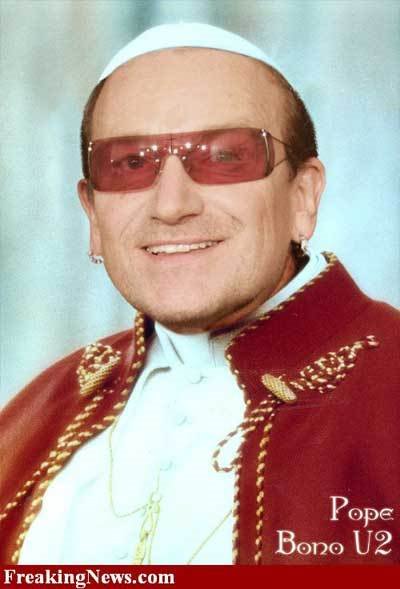
Here is a link to an AP story on U2 masses that some ECUSA parishes are having. These are services where they use music by the rock group U2 for the liturgy. I think some churches have a cover band play the music, while others just spin the CD. U2 has granted there permission for churches to use their music in this way. Many of their songs have a Christian, or generalized religious, or other socially redeeming theme to them. There are even books out on using U2 songs to help write sermons. Now, I like U2, and I even have a few of their CDs on my I-Pod, but I don't think their music is suitable for the corporate worship of the church. The rock and roll medium is too simplistic, market-driven, and transitory to be used for the public worship of the eternal, Triune God of the universe. The banal words to most rock and roll songs draw attention mainly to themselves, and so the song and the group becomes the point of everything... not God. Further, rock and roll music is emotionally driven. The way many popular rock songs are composed (if one can use that word) causes people listening to them to be whipped into an emotional frenzy, clouding reason and intellect. Public Christian worship consists in large part of a perfect balance between reason and emotion. The ECUSA parishes that are doing this have reported that large numbers of young people have been drawn out to the services. But do they continue to come back? Do services that use this type of music have enough spiritual depth to sustain these apparant "conversions"? I doubt it. More important, do the churches holding these services really teach the Christian faith at all, with its great themes of creation, fall, and redemption? If not, then I don't care what kind of music you have playing, people will not come to the church. If there is no spiritual need for salvation, as many mainline churches seem to teach, then why go to church at all?
Thursday, April 13, 2006
Baptisms Down
A news link on New Oxford Review reports that baptisms are declining in many churches... from the Southern Baptists to the Roman Catholics. One of the main reasons this is happening, acccording to the article, is because of interfaith marriage: people marry outside of their Christian tradition - or even outside of the Church - and decide to let their kids get baptized when they feel the time is right. They let it be their childrens' choice. Hmmm, I wonder if they would take one of their sons and say, "Well, let's not raise him as a boy or a girl. When he is old enough he can make his own decision as to which sex he wants to be." Or, "Let's not raise little Johnny to be financially secure and responsible, but instead we'll let him decide if he wants to be poor or middle class." That's what these parents are doing with the grace of God in baptism. They are robbing their children of it. If there is friction about whether or not the child should be baptized, then the couple should not be getting married in the first place. Christians should not marry unbelievers (or even "nominal" Christians) anyway - even as the children of Israel were forbidden to intermarry with the Canaanites. Too many churches do not teach what the scriptures teach in this area, and the world and the Church is worse off for it. In the evangelical/baptist world, I suspect one of the reasons for the downward trend in baptism has something to do with the whole "getting saved" theology. Why get baptized when you don't need it to get "saved". Since their faith is not incarnational, or even anti-incarnational, they see no need for sacraments. The Christian faith is mere assent to certain intellectual propositions, and living a morally upstanding life.
Sunday, April 09, 2006
N.T. Wright and Jackson Pollock
 Lately I have been reading The New Testament and the People of God by N.T. Wright. The beginning section of the book deals with hermeneutics. One of the problems people face in reading texts these days is whether or not a text actually refers to anything real. In reading a story about some event, can it actually convey anything truthful about the event, or does it only tell us only what the author is thinking about? Indeed, some are of the opinion that a story/text really tells us about the mind of author, and nothing more, and so they look for clues in the book to find out about the author's personal life. Wright basically says that this idea is a bunch of bunk.
There is an interesting connection here to art history and art interpretation. Some people think that in looking at an artist's work they can somehow find out about his or her personal belief system, or discover what philosophy he or she followed. Theories like that make for interesting reading at times, but it must be remembered that they are always, in the end, merely speculation and theories. With that in mind, Jackson Pollock is a favorite whipping boy of people like Francis Schaffer. They say that his art shows how meaningless he thought life and the world was. But I don't think his work can be written off that easily. His drip paintings are extremely beautiful (you really have to go see one in person), and are wonderful studies in formless painting. They ought to be apprciated for what they are, and not used as a jumping-off point for mindless speculation about his personal life. The same thing is true with reading the NT. It is meant to be read for what it is.
NOR Subscription
Special thanks to St. George the Orthodox, who comments on the blog, for getting me a subscription to the New Oxford Review! Thinking of leaving Anglicanism for the wonderful majesty, uniformity in faith and liturgy, and orthodoxy and traditionalism of Rome? Better subscribe to this magazine first. Rome "ain't all its cracked up to be." I think I might buy myself the Book "Papal Sins" as a little companion piece to this fine magazine.
Friday, April 07, 2006
Passion de Jeanne d'Arc
 Tonight we have a post-confirmation age youth activity. This is my kind of activity: we are going to watch the classic silent film "Passion de Jeanne d'Arc", by Carl Dreyer. This movie has quite a history. Dreyer was urged to make all sorts of changes to the film so the public would like it better. He did so, but they lost their edge, and the film flopped. Meanwhile, the few original prints remaining were lost to various fires. But in 1982, an orginal print was found in the closet of an Oslo insane asylum. It was restored, and a fantastic soundtrack was composed by Einhorn (Voices of Light). The restored orginial with the new soundtrack is absolutely amazing.
The acting is great. It is amazing how you know exactly what is going on, and what the people are saying and thinking even if there are no subtitles. They do it all through their expert facial expressions and gestures. The close-ups and camara angles are astounding and dramatic. It shows how silly most modern movies are, and how studios prefer to use technology, cgi, and special effects instead of the skills of the actor or actress (and the director of photography too, for that matter). If you have never watched a silent film, I recommend this one, as it is a good introduction to the genre.
I hope they like it. There are a few who I think will definitely enjoy it. Not sure about the others. Either way, it will be a great film to see, and a good teaching tool. When I was a kid I hated youth group... with all of the goofy games, the guitar-strumming "kumba ya" music, and all the rest of it. I loved church, and I loved hymns, but I disliked the silliness associated with the youth group. Something like this would have been right up my alley.
Thursday, April 06, 2006
My First Mass
It turns out that my first Holy Eucharist will be celebrated the day after my ordination. As that day is a Sunday, and the bishop will be present for confirmations, my first mass will be celebrated in his presence at the main parish mass. Nothing like a little pressure on a guy! At least it won't be a solemn high. Also, my wife will be among those being confirmed that day, so that will add to the pressure as well. Once that is done, I will have to do more masses. For the rector tells me that it is customary that a new priest celebrate three votive masses on the first three ferial days after his ordination: one for the Holy Spirit, one in honor of Our Lady, and one Requiem (for departed family members). So I guess I need to plan those sometime soon.
Tuesday, April 04, 2006
Private Interpretation and Authority
I am working on my sermon for Palm Sunday. The rector lets me preach several times a month, which is great practice, and I am honored to be allowed to preach on such an important day. Sometimes sermon prep can be very difficult, especially when the passage of scripture appointed for the day is cryptic. Interpreting these passages properly is tricky and requires lots of thought, study, and reflection. I use a variety of commentaries to help me in interpreting these passages, as well as to get ideas on how to approach them.
All of this got me thinking about corporate vs. private interpretation of the scriptures. Over on the fundamentalist Roman Catholic blog, Pontifications, they often talk about private interpretation the scriptures, and how that is one of "problems" associated with Protestantism. In the Roman Church, it is the Magesterium that interprets the scriptures in a way that is normative for the life of the Church, whereas individual Protestants (supposedly) just blindly read the Bible and make it say whatever they want. Often those who harp on this issue believe that the various moral and social challenges facing the Church and other "ecclesial entities" today have come about directly because of the sin of "private interpretation". Honestly, though, I think that is over simplifying the situation. And the more I think about it, the less difference I see between the two camps. The Roman Catholic Church interprets scripture in the same way that other churches do. They use the same tools and techniques, and read the same commentaries, and look at the same documents from the Tradition, as everyone else does. They do not have a secret "stash" of biblical commentaries known only to them.
The main difference would appear to be the magesterium. The magesterium of the Church really acts as the "referee" in the game. And while it is the bishops that form the magesterium of the Church, they clearly depend on the work of biblical scholars, theologians, and other experts to help them make their official decisions and pronouncements. So, in actual fact, the Roman Catholic magesterium is not as authoritarian in these areas as people think. Put another way, they do not just sit around and spout off opinions and interpretations, but very carefully listen the experts, pray, read, and study, just like everyone else. In the end they simply rubber stamp what has been a long, rational, and reflective process. And while I believe that the pontiff could theorectically just announce a particular interpretation of a passage as being "the one true interpretation for all time and space", it would obviously be highly unusual for that to occur. The magesterium also has the responsibility to make sure Roman Catholic clergy adhere to these teachings and decisions. This difference (the role of the magesterium in scriputre interpretation) is very enticing to certain people, and causes many to convert to Roman Catholicism. But is there even this difference between Roman Catholics and Protestants?
All churches have a magesterium - that is to say, a body that decides what is or is not normative for the life of the Church in terms of scriptural interpretation and doctrine. Is there no authority in Protestantism? Or in Anglicanism? Don't tell Bp. Bennison, or Bp. Shaw, or Bp. Ilhoff that. They will laugh right in your face. Of course they have authority, and as we all know, they exercise it very well! Do ECUSA bishops not interpret the scriptures in a way that is normative for their church? Of course they do! Those (ECUSA) bishops and there colleagues have and do interpret the scriptures in a way that is normative for the life of their church. In both ways, protestant denominations are the same as Rome. Even extremely Protestant traditions/denominations, such as Presbyterians, do not allow a minister to get up and say and teach whatever he wants to say and teach. He must conform to the received tradition of his church. There is authority, and authoritative scripture interpretation, in every church. Ultimately one must choose which church's authority and teaching to submit himself to.
All of this got me thinking about corporate vs. private interpretation of the scriptures. Over on the fundamentalist Roman Catholic blog, Pontifications, they often talk about private interpretation the scriptures, and how that is one of "problems" associated with Protestantism. In the Roman Church, it is the Magesterium that interprets the scriptures in a way that is normative for the life of the Church, whereas individual Protestants (supposedly) just blindly read the Bible and make it say whatever they want. Often those who harp on this issue believe that the various moral and social challenges facing the Church and other "ecclesial entities" today have come about directly because of the sin of "private interpretation". Honestly, though, I think that is over simplifying the situation. And the more I think about it, the less difference I see between the two camps. The Roman Catholic Church interprets scripture in the same way that other churches do. They use the same tools and techniques, and read the same commentaries, and look at the same documents from the Tradition, as everyone else does. They do not have a secret "stash" of biblical commentaries known only to them.
The main difference would appear to be the magesterium. The magesterium of the Church really acts as the "referee" in the game. And while it is the bishops that form the magesterium of the Church, they clearly depend on the work of biblical scholars, theologians, and other experts to help them make their official decisions and pronouncements. So, in actual fact, the Roman Catholic magesterium is not as authoritarian in these areas as people think. Put another way, they do not just sit around and spout off opinions and interpretations, but very carefully listen the experts, pray, read, and study, just like everyone else. In the end they simply rubber stamp what has been a long, rational, and reflective process. And while I believe that the pontiff could theorectically just announce a particular interpretation of a passage as being "the one true interpretation for all time and space", it would obviously be highly unusual for that to occur. The magesterium also has the responsibility to make sure Roman Catholic clergy adhere to these teachings and decisions. This difference (the role of the magesterium in scriputre interpretation) is very enticing to certain people, and causes many to convert to Roman Catholicism. But is there even this difference between Roman Catholics and Protestants?
All churches have a magesterium - that is to say, a body that decides what is or is not normative for the life of the Church in terms of scriptural interpretation and doctrine. Is there no authority in Protestantism? Or in Anglicanism? Don't tell Bp. Bennison, or Bp. Shaw, or Bp. Ilhoff that. They will laugh right in your face. Of course they have authority, and as we all know, they exercise it very well! Do ECUSA bishops not interpret the scriptures in a way that is normative for their church? Of course they do! Those (ECUSA) bishops and there colleagues have and do interpret the scriptures in a way that is normative for the life of their church. In both ways, protestant denominations are the same as Rome. Even extremely Protestant traditions/denominations, such as Presbyterians, do not allow a minister to get up and say and teach whatever he wants to say and teach. He must conform to the received tradition of his church. There is authority, and authoritative scripture interpretation, in every church. Ultimately one must choose which church's authority and teaching to submit himself to.
Friday, March 31, 2006
Transforming Lives
"The church is about transforming peoples' lives not letting them live in their sin and delusion. And one of the reasons for the decline is that if you have no specific salvific message to proclaim or a mission statement that does not make sense of peoples' real lives, there is little incentive to roll out of bed on Sunday morning if what you think you will hear in the pulpit is a rehash of the op-ed page of the New York Times or a major whine about why the Christian Church is homophobic."
From Virtuosity
David Virtue hits the nail on the when speaking of the decline of ECUSA. Indeed what he says is relative to many other denominations too. Sadly, though, it is worth noting that even traditionalist "continuing" churches can slip into this mindest, where something other than worship, evangelism, and mission becomes the most important thing.
From Virtuosity
David Virtue hits the nail on the when speaking of the decline of ECUSA. Indeed what he says is relative to many other denominations too. Sadly, though, it is worth noting that even traditionalist "continuing" churches can slip into this mindest, where something other than worship, evangelism, and mission becomes the most important thing.
Wednesday, March 29, 2006
Church Restoration - Wrapping It Up
Well, as I prepare for new things in my career I am slowly phasing out of my work in church restoration (primarily in stained glass, but also other areas). This business has occupied four years of my life, and I have learned a great deal about art, churches, and people through it. I have a few observations and stats that some of you might find interesting. Keep in mind that there are exceptions to each of these, and also that some of the results may be due to the fact that I live in the mid-Atlantic region (i.e. mid-western churches are probably a lot friendlier).
My Best Customers:
ECUSA parishes. They really care about their buildings, and have given me lots of business.
Best Churches to Cold Call:
ECUSA parishes. They are incredibly friendly, I have found, and they love to show off their buildings. Next come orthodox parishes, then ELCA and LCMS parishes.
Rudest Churches to Deal With and Cold Call:
Roman Catholic... by far. Generally speaking, I have never met a more rude and arrogant bunch of people than the priests of the Archdiocese of Baltimore. And the more conservative the parish/diocese, the worse they are to deal with. Their cronies they have working for them at the "power tower" (the nickname for the Archdiocese's high rise office building downtown) are just as bad. After them come the Methodists, then the Presbyterians.
Churches that are the Hardest to Make Contact With:
Black churches that are not part of a mainline denomination. No one is ever at the building during the week. Next come the Roman Catholics... these guys do not even come to the door half of the time.
Churches Where You Are Most Likely to Get Hit On (by a man):
ECUSA parishes, followed by Tridentine-Rite RC parishes
Churches That You Can Count on Getting Very Little, if any, Business From:
Any conservative church that is part of a conservative denomination (e.g. not a FiFNa type of parish). PCA, LCMS, OPC, ARP, Continuing Churches, etc.... they usually do not care about externals and arts, or they are very poor, and prefer to funnel their money to ministry. Independant black churches are also usually too poor to do anything about their building, or do not seem to care that much about it. Orthodox churches are hard to get business from too. They always have "some guy over in Syria/Russia/Greece, etc." who is going to paint their icons, or design their windows, or something.
Churches Where There is Often a Pet Running Around the Building:
ECUSA parishes... I have seen dogs and cats in many a nave.
My Best Customers:
ECUSA parishes. They really care about their buildings, and have given me lots of business.
Best Churches to Cold Call:
ECUSA parishes. They are incredibly friendly, I have found, and they love to show off their buildings. Next come orthodox parishes, then ELCA and LCMS parishes.
Rudest Churches to Deal With and Cold Call:
Roman Catholic... by far. Generally speaking, I have never met a more rude and arrogant bunch of people than the priests of the Archdiocese of Baltimore. And the more conservative the parish/diocese, the worse they are to deal with. Their cronies they have working for them at the "power tower" (the nickname for the Archdiocese's high rise office building downtown) are just as bad. After them come the Methodists, then the Presbyterians.
Churches that are the Hardest to Make Contact With:
Black churches that are not part of a mainline denomination. No one is ever at the building during the week. Next come the Roman Catholics... these guys do not even come to the door half of the time.
Churches Where You Are Most Likely to Get Hit On (by a man):
ECUSA parishes, followed by Tridentine-Rite RC parishes
Churches That You Can Count on Getting Very Little, if any, Business From:
Any conservative church that is part of a conservative denomination (e.g. not a FiFNa type of parish). PCA, LCMS, OPC, ARP, Continuing Churches, etc.... they usually do not care about externals and arts, or they are very poor, and prefer to funnel their money to ministry. Independant black churches are also usually too poor to do anything about their building, or do not seem to care that much about it. Orthodox churches are hard to get business from too. They always have "some guy over in Syria/Russia/Greece, etc." who is going to paint their icons, or design their windows, or something.
Churches Where There is Often a Pet Running Around the Building:
ECUSA parishes... I have seen dogs and cats in many a nave.
Tuesday, March 28, 2006
Personality Type and Religious Leadership
Recently I found an interesting book entitled "Personality Type and Religious Leadership" (Roy Oswald and Otto Kroeger, 1988) in my seminary's library. It uses the Myers-Briggs Type Indicator (MBTI) test to assess strengths and weaknesses in the ministry, potential pitfalls, types of prayer, role and pastoral function, and more. It has been quite enlightening reading this book. My type accounts for about 10% of clergy. In thinking of ministering with other clergy in a parish setting much thought must be given to match clerical personalities for the best possible results. As clergy candidates are usually required to take this test (along with other tests too) it would behove church leadership to use the insight gained from them in assigning clergy, so that everyone can minister in the most effective way possible.
Monday, March 27, 2006
No Way APA
A wonderful anglo-catholic friend in the early stages of pursuing holy orders told me over some drinks the other night that he had come across the the "No Way APA" website. We joked at how silly it is. This site is run by someone who is obviously not excited about the APA and REC merging. For it exposes all of the "awful" catholic things that we do in the APA.
To be sure, it is accurate in some ways. Yes, we do offer the Blessed Virgin Mary the WORTH-ship (hyperdulia) that she is worthy of; we do recommend and practice private confession as it is one of the seven sacraments; we have lots of ritual (following Ritual Notes, of course); we celebrate the Sacrifice of the Mass; we pray for the dead; and more. But it is inaccurate in other ways. First of all, we worship (dulia) other saints too...not only Mary. Also, the site suggests that we have only "semi-nuns". I object to that... we have full nuns, just to set the record straight (The Order of St. Athanasius).
It is worth noting that the "No Way APA" website has been condemned by the bishops of the REC, who, besides being thoroughly catholic, are in full support of merging with the APA. It is too bad that those running it do not take the time to learn and study about catholic theology. Sadly, their error is just as bad as the ultramontane Roman Catholic who erects all sorts of straw men about protestantism, and never takes the time to seriously study it.
To be sure, it is accurate in some ways. Yes, we do offer the Blessed Virgin Mary the WORTH-ship (hyperdulia) that she is worthy of; we do recommend and practice private confession as it is one of the seven sacraments; we have lots of ritual (following Ritual Notes, of course); we celebrate the Sacrifice of the Mass; we pray for the dead; and more. But it is inaccurate in other ways. First of all, we worship (dulia) other saints too...not only Mary. Also, the site suggests that we have only "semi-nuns". I object to that... we have full nuns, just to set the record straight (The Order of St. Athanasius).
It is worth noting that the "No Way APA" website has been condemned by the bishops of the REC, who, besides being thoroughly catholic, are in full support of merging with the APA. It is too bad that those running it do not take the time to learn and study about catholic theology. Sadly, their error is just as bad as the ultramontane Roman Catholic who erects all sorts of straw men about protestantism, and never takes the time to seriously study it.
Thursday, March 23, 2006
Comparing Recent Reading
Lately, I have begun reading The New Testament and the People of God by N.T. Wright. Lord willing, I plan to read his whole series on Christian origins (3 volumes thus far - around 3,000 pages). Wright, Anglican Bishop of Durham, is probably the world's foremost NT scholar. When I was seminary Raymond Brown (who taught at my alma mater for many years) and Joseph Fitzmeyer were viewed as demi-gods.... all we did was read their works, discuss their writings, etc. So, it is going to be nice to get another point of view, though those two are very fair and centerist scholars.
I think that the crisis in biblical studies and interpretation, in addition to the question of authority, are the most pressing issues facing the church today. They are, in my judgement, the direct cause of all of the heresy that the church has infected the church over the last 35 years or so. It is more than a question of authority (e.g. magesterium/papacy) alone, as some Christians seem to think.
The central problem is knowledge and interpretation. Wright advocates a critical realist epistemology and approach to the scriptures over and above a positivistic or completely subjectivist/reader-response type of approach. This reading is a nice contrast to John MacQuarrie's existentialist-Bultmannian approach in Principles of Christian Theology, which I am in the process of finishing up. Briefly, critical realism in the theory of knowledge still allows for something of a Kantian subject-object distinction typically associated with positivism, but also affirms that we genuinely interact with the "object" and bring our own worldview and presuppositions to it. It does not allow for "brute facts", nor does it feign complete objectivity (a common error made in the realm of science). This is a sound principle to keep in mind, not only when reading theology, but when looking at art, listening to music, etc. We do not always interpret various things in exactly the same way, but there are a lot of similarities. Critical realism does allow one to speak truly of reality, but affirms the challenges wrought by reflection and contemplation, as well as the interplay of our presuppositions. Central to Wright's critical realist approach is the idea of the "story". Verification does not happen as a result of observing sense data to see if they fit a hypothesis, but by devising means based on a larger "story", which includes the hypothesis itself. I realize that is confusing, but I don't have room to go into it more. You can read about on pp.38-46 of his book. But suffice it to say, "story" is used in the same way as "worldview". I think that his use of story in this sense is similar to David Tracy's idea of the "classic" (i.e. a classic book), but I will not go into that now.
John Macquarrie, in my opinion, grants far too much neutrality and objectivity to the field of science and biblical studies. He assumes that the movers and shakers in those fields have no bias in their work, which is quite a faulty assumption. And while it doesn't undermine his whole existentialist philosophical theology, I think that it does weaken it at various points. Despite that, Macquarrie still shines - albeit in other ways. I think that his approach, once understood and mastered, is a very creative way to describe and discuss the Christian faith. It is quite useful to be able to explain the tenants of our faith in a variety of ways to reach as many people as possible, so long, of course, as you arrive at the same place. I can see how his model would be more attractive to people of a certain mindset than, say, reciting "Fundamentals of Catholic Dogma" to them, or talking about how an angel came and visited me one afternoon.
It is good to read a few books at once, especially in related fields, as it can help in understanding them better, and help one get more out of them. I highly suggest both of these books and authors.
I think that the crisis in biblical studies and interpretation, in addition to the question of authority, are the most pressing issues facing the church today. They are, in my judgement, the direct cause of all of the heresy that the church has infected the church over the last 35 years or so. It is more than a question of authority (e.g. magesterium/papacy) alone, as some Christians seem to think.
The central problem is knowledge and interpretation. Wright advocates a critical realist epistemology and approach to the scriptures over and above a positivistic or completely subjectivist/reader-response type of approach. This reading is a nice contrast to John MacQuarrie's existentialist-Bultmannian approach in Principles of Christian Theology, which I am in the process of finishing up. Briefly, critical realism in the theory of knowledge still allows for something of a Kantian subject-object distinction typically associated with positivism, but also affirms that we genuinely interact with the "object" and bring our own worldview and presuppositions to it. It does not allow for "brute facts", nor does it feign complete objectivity (a common error made in the realm of science). This is a sound principle to keep in mind, not only when reading theology, but when looking at art, listening to music, etc. We do not always interpret various things in exactly the same way, but there are a lot of similarities. Critical realism does allow one to speak truly of reality, but affirms the challenges wrought by reflection and contemplation, as well as the interplay of our presuppositions. Central to Wright's critical realist approach is the idea of the "story". Verification does not happen as a result of observing sense data to see if they fit a hypothesis, but by devising means based on a larger "story", which includes the hypothesis itself. I realize that is confusing, but I don't have room to go into it more. You can read about on pp.38-46 of his book. But suffice it to say, "story" is used in the same way as "worldview". I think that his use of story in this sense is similar to David Tracy's idea of the "classic" (i.e. a classic book), but I will not go into that now.
John Macquarrie, in my opinion, grants far too much neutrality and objectivity to the field of science and biblical studies. He assumes that the movers and shakers in those fields have no bias in their work, which is quite a faulty assumption. And while it doesn't undermine his whole existentialist philosophical theology, I think that it does weaken it at various points. Despite that, Macquarrie still shines - albeit in other ways. I think that his approach, once understood and mastered, is a very creative way to describe and discuss the Christian faith. It is quite useful to be able to explain the tenants of our faith in a variety of ways to reach as many people as possible, so long, of course, as you arrive at the same place. I can see how his model would be more attractive to people of a certain mindset than, say, reciting "Fundamentals of Catholic Dogma" to them, or talking about how an angel came and visited me one afternoon.
It is good to read a few books at once, especially in related fields, as it can help in understanding them better, and help one get more out of them. I highly suggest both of these books and authors.
Altar Girls in Arlington, VA
News from the Roman Catholic Diocese of Arlington... they have finally permitted altar girls to serve during mass at parishes. Previously they allowed girls to be servers in some instances. This just makes their policy more consistent. Though the article doesn't say it, I have been told that the diocese requires male and female altar servers to dress differently so as to make sure people understand the physical distinction between them. Apparently the bishop thinks that allowing females to serve at the altar will increase the number of vocations to the religious life. Maybe it will, but it sure hasn't done that here in the Archdiocese of Baltimore, or anywhere else that I can think of for that matter. One thing it does seem to have increased is the desire among certain RCs to ordain women.
Personally, I maintain my general opposition to female altar servers, but believe that women can and should serve in important leadership positions in the local and national church (e.g. vestry, teaching and preaching, diocesan committees, professorships, etc.) if they so desire.
Personally, I maintain my general opposition to female altar servers, but believe that women can and should serve in important leadership positions in the local and national church (e.g. vestry, teaching and preaching, diocesan committees, professorships, etc.) if they so desire.
Tuesday, March 21, 2006
Thomas Cranmer, R.I.P.
Today marks the death of Thomas Cranmer, who, as we all know, was burned at the stake under Mary Tudor. I found out from the MacCulloch biography that his last meal consisted of spice cakes and bread; fruit and nuts; and a dish of stewed prunes (p. 599). Talk about adding insult to injury!
In Need of Immediate Feedback!
I am having five sets of vestments made for me by Renzetti & Magnarelli in Philadelphia. They are going to be white, red, green, violet, and black chasubles (eventually I hope to get rose and gold as well), with the old "spade-style" maniples and stoles, and also some matching burses and veils. Of course the chasubles will be lined and done in the "fiddleback" style. As R & M only does custom work, they will each have varying brocades, bandings, fringes, along with some embroidered crosses, etc. The banding pattern that they use in the front is absolutely exquisite, so there is no need for an orphrey on that side. But now I am wondering about the back: should I have an orphrey put on it? Otherwise, the back will just be plain with the banding going around the edge, and maybe some banding on top. Part of me thinks that having the back plain will give the chasuble a nice, modest look to it. But then again, I do not want it to be too stark. Any opinions? Oh, and the other thing is that I generally have not liked a lot of the orphrey designs that I have seen on the backs of fiddleback chasubles.
Friday, March 17, 2006
Spanish Deacon's Mass
I have been asked to do a deacon's mass ("Sunday Mass in Absence of a Priest", for all of you Roman Catholics out there) at a latino parish of ours. This involves learning to read the various parts of the liturgy decently, and having my sermon translated. Luckily, my wife speaks Spanish fluently, so she can help me out with my pronunciation, and also with translating my sermon for me as I give it. Tip of the biretta, by the way, to Fr. Erich Zwingert, SSC, for suggesting me. This will be my first, and probably last, deacon's mass, as my ordination to the sacred preisthood is fast approaching.
A continuing church bishop once told me that latino Anglicans were the strangest thing he had ever heard of in his life. But he was a rather cynical fellow. Personally, I don't see anything wrong with there being latino Anglicans. It would be like saying there is something wrong with being white, American, and Antiochian Orthodox. Sure, it might be a bit unusual, but it's not like the "church police" are going to come out and arrest you if you happen to be latino and Anglican. It will be interesting to see how they worship. Apparently, they do not use the 1940 Hymnal, and they have a worship band complete with an accordian. Now that sounds pretty cool! Maybe I should bring my banjo along.
A continuing church bishop once told me that latino Anglicans were the strangest thing he had ever heard of in his life. But he was a rather cynical fellow. Personally, I don't see anything wrong with there being latino Anglicans. It would be like saying there is something wrong with being white, American, and Antiochian Orthodox. Sure, it might be a bit unusual, but it's not like the "church police" are going to come out and arrest you if you happen to be latino and Anglican. It will be interesting to see how they worship. Apparently, they do not use the 1940 Hymnal, and they have a worship band complete with an accordian. Now that sounds pretty cool! Maybe I should bring my banjo along.
Monday, March 13, 2006
The Psychology of Religion
I am becoming more and more interested lately in the role our personal psychological composition (e.g. personality type, and so on) plays in the religious choices that we make. We make it seem at times that we are what we are - Roman, Anglican, Presbyterian, etc. - based entirely on reason alone. But I think that if we were honest with ourselves we'd realize that so much more goes into making the religious choices that we do. I once jokingly remarked to a vehemently anti-catholic friend when we were arguing about Catholicism (I was Roman Catholic at the time), "What... did you get beat up by a neighbor who was Roman Catholic when you were a kid, or something? Is that why you hate RCism so much?" My point being that he seemed to have more of an affective aversion to RCism rather than intellectual one; it was something deeper, something more primitive within him. Not something less valuable or important, but just different.
Some people, in my experience, seem to prefer subscribing to theological systems that purport to have answers for everything, or they are looking for a particular unshakeable and infallible authority to ease their troubled soul (pope, sola scriptura, etc.), while others are drawn to and convinced by systems that are very amorphous and ambiguous. Either preference, though, seems to be driven more by an individual's psychology and personality rather than being a purely disinterested pursuit of "truth", though the quest for truth certainly does come into the equation. And as we are constantly developing and growing as individuals, our psychology is influenced more and more by the various life experiences that we grow through, and we bring all of that to the table as well.
We all do this. I think about this in relation to my own life as an artist-deacon. As an artist, I am fine with seeing things from multiple perspectives, and am not necessarily worried about how it all ties together. My "looser" mindset even trickles into the country/bluegrass band me and some friends have: I always joke with them that I am not very concerned with staying in strict time, people coming in singing all at once, and so on, and how that is analogous to the dripping paint, multiple perspective, and criss-crossing lines in my art. I think it is that inherent ambiguity that I live with as an artist that has helped me remain faithful to Jesus Christ in times of darkness over the years. Other people though, could not stand having dripping paint, and "gray" areas to deal with. To them, everything is black and white, and very often they think that anyone who accepts some level of ambiguity is a complete wacko. I accept that there are people like that out there... who have to have neat answers for everything; that is their personality type, and that's fine. That's how God made them, and allowed them to grow as people. But I do find it frustrating to read of people who write about their religious life, or conversion to another denomination, as though it were entirely an intellectual matter, when, no doubt, personal and psychological reasons were also at play. It just seems dishonest.
People make decisions for personal reasons as well as for intellectual ones. It is not just a bare examination of the 'cold, hard facts'. I think that when people begin to acknowledge this more it will bear fruit ecumenically, as well as in other ways.
Some people, in my experience, seem to prefer subscribing to theological systems that purport to have answers for everything, or they are looking for a particular unshakeable and infallible authority to ease their troubled soul (pope, sola scriptura, etc.), while others are drawn to and convinced by systems that are very amorphous and ambiguous. Either preference, though, seems to be driven more by an individual's psychology and personality rather than being a purely disinterested pursuit of "truth", though the quest for truth certainly does come into the equation. And as we are constantly developing and growing as individuals, our psychology is influenced more and more by the various life experiences that we grow through, and we bring all of that to the table as well.
We all do this. I think about this in relation to my own life as an artist-deacon. As an artist, I am fine with seeing things from multiple perspectives, and am not necessarily worried about how it all ties together. My "looser" mindset even trickles into the country/bluegrass band me and some friends have: I always joke with them that I am not very concerned with staying in strict time, people coming in singing all at once, and so on, and how that is analogous to the dripping paint, multiple perspective, and criss-crossing lines in my art. I think it is that inherent ambiguity that I live with as an artist that has helped me remain faithful to Jesus Christ in times of darkness over the years. Other people though, could not stand having dripping paint, and "gray" areas to deal with. To them, everything is black and white, and very often they think that anyone who accepts some level of ambiguity is a complete wacko. I accept that there are people like that out there... who have to have neat answers for everything; that is their personality type, and that's fine. That's how God made them, and allowed them to grow as people. But I do find it frustrating to read of people who write about their religious life, or conversion to another denomination, as though it were entirely an intellectual matter, when, no doubt, personal and psychological reasons were also at play. It just seems dishonest.
People make decisions for personal reasons as well as for intellectual ones. It is not just a bare examination of the 'cold, hard facts'. I think that when people begin to acknowledge this more it will bear fruit ecumenically, as well as in other ways.
Subscribe to:
Posts (Atom)